Showing posts with label Inspiration. Show all posts

Monday, 23 March 2009

Cabinet of Curiosities


The last few lines from our scrawled directions was "keep the clock tower on your right... turn right into the mews... the second wooden gate on the left after a pair of pointed old-fashioned bollards, then up the cast iron stairs up to the front door lined with many flower pots..." And so we arrived at Jane Wildgoose's Memorial Library.

The charming door opened to reveal Jane herself, who ushered us in from the soggy weather outside and into her warm, inviting and quite frankly fascinating home. Minutes later we found ourselves in the library - Jane's studio and study - gas-fire glowing, gold and white tea set tinkling.

Behind me was this marvelous cabinet of curiosities (image below), glass doors open and inviting the visitor to engage their every sense, including touch. It is this in part that makes this a library and not a museum, as Jane believes that objects can be read and indeed carry a life of their own. She recalls her memories as a child by the seaside and, like many children, her instinct to peruse and collect from the offerings of the tide; this instinct to collect combined with her early experiences of old age and death as a child combined into a fascination and exploration of our treatment of death, life and all its rituals.


Each object and item is "... designed to facilitate meditation and free associations on subjects pertaining to the mysteries of the living in relation to the dead, transience, memory and immortality." The thoughtful placement of each object creates a visual language that allows us to consider the items within a greater subject; This talent for display is essential to the work as without their context certain pieces could be discarded as mundane or common, but within their frames they come alive with meaning. 

Among the many items arrayed, I inspected Victorian locks of hair encased in glass-fronted lockets and rings, coiled and twisted to resemble feather plumes; I was part horrified, part comically delighted by a ridiculous armadillo handbag with little claws that encircled it's round body, the clasp a gleaming cyclops; Various glass boxes contained petrified animal remains, crumbling in their beds of velvet in their miniature coffins. Dried and decaying pomegranates also feature regularly throughout the display as the library is dedicated to the mythic Queen of the Underworld, Persephone.

There is a striking sense of peace in the library, a calmness and sense of belonging conveyed through the warm presence of Jane. She provides a dedicated space for reflection without the implications or specific rituals of religion. Her patience and eagerness to share her work and discoveries over steaming cups of tea is infectious, and we left the Wildgoose Memorial Library brimming with enthusiasm and small awakenings. Thank you Jane for a truly inspiring day.


Inspired by our afternoon at the library, I did a little image search for 'cabinet of curiosities'. Taxidermy, shells, coral, fossils, minerals and other petrified life-forms are popular themes, as are anatomical anomalies and wonders. The strange, the unusual, the ugly and the beautiful are all welcome here in our efforts to understand ourselves and the world in which we find ourselves, or indeed simply to appreciate them for their aesthetic and individual properties.

The Artist in his Museum, Charles Willson Peale (self-portrait), 1822.

The partially lost collection or Georg Gasser (1857 - 1931), an artist and painter who collected 2000 mineral specimens, 5000 petrefacts, 2000 shells, and various animals and skeletons of all kinds. The remains of his collection have formed a new museum in Bozen.

Teylers Museum, Haarlem, The Netherlands.

Cabinet of Curiosities, Unknown, late 17th century,
oil on canvas, Florence, Opficio delle Pietre Dure.

A medical book from the marvelous blog Morbid Anatomy at blogspot.

Cabinet of Curiosities, second half of the 17th C., Dommuseum du Salzburg, Austria.

Ole Worm, Museum Wormianum, Leiden, 1655. Illustration of a 17th century cabinet of curiosities.

And with that, I close the curtain upon this particular cabinet and I hope it contained some inspiring wonders. Thank you for reading...

Wednesday, 11 March 2009

Rapunzel & Bluebeard Inspirations


Just a few images I've selected from my research to share with you.
I absolutely adore the image above, which I discovered through the lovely Florizelle and her beautiful blog Le Divan Fumoir Bohemien.

The tower of Rapunzel? The eternal tears of the dead wives of wicked Bluebeard?

This season, Lagerfeld's paper magic for Chanel Spring/Summer made for a unique collection.

Hair has been an obvious source of inspiration in exploring Rapunzel. I have also been taken by the idea of relics and reliquaries, and the many ways in which we preserve mementoes and keepsakes, making them sacred. These are the locks of two women and those of their lovers, away at war.


The magical work of Su Blackwell... someone whom always seems to pop up as a reference for me. She was featured recently in Vogue where one of her creations was the enchanting scene for a jewelry spread.


Friday, 20 February 2009

Natural Fashion

We've just started a new module at university titled 'The Body Adorned'. We haven't been given an incredibly detailed brief yet, but I immediately thought of this book that I fell in love with recently titled Natural Fashion: Tribal Decoration from Africa by Hans Silvester. It is an intriguing example of the kind of creativity that springs from humanity living in abundance and simbiosis with nature. The Surma and Mursi tribes of East Africa live near the busy streams and rivers that cut through the dry savannahs of the Rift, allowing for a bounty of fruit trees, grasses, flowers and papyrus to flourish. Especially before the arrival of the rain season, the hot weather encourages families down to the cooling shades of the water, where the inspiring raw materials for their creations lie. As Silvester notes; 

"For Westerners, any such activity might demand great intellectual effort - which branch, what colour, how and where should they be arranged? - and the whole process could seem laborious... but here people make their choices spontaneously but firmly... They live so closely to nature that they also act naturally..."


The Rift Valley is blessed with a rich paint-box of minerals and earth pigments. Red, ochre, shades of white, yellow and light grey - with the exception of blue, the tribes have access to concentrated colour that contrast beautifully with the coppery tone of their skin. The painting also has the practical property of protecting them from sun exposure. The pigments dry within seconds, which give the artists a spontaneous incentive to act in bursts.


What I find so fascinating is Silvester's thoughts on the up until recent absence of mirrors in these tribes. Even the rivers are too silty to provide a clear reflection, leaving the response and reaction of others as a measure. Since your self-image is determined through the eyes of others, the practice of body-painting and decoration is rarely done alone, and often in teams.  


Surely what we are seeing is one of the very first art forms - more than likely far far older than cave paintings and other recordable varieties. This close interaction with nature requires a knowledge of the properties of each material, leading to a tactile understanding and instinct for the environment. Perhaps this enjoyable way of learning was intrinsic to our survival - and how apt that this very human instinct to create and touch should still thrive in what is often referred to as the 'Cradle of Humanity'.


And just quickly (that was quite a big sentence I wrote up there), a slightly less spontaneous example of our rather more studied approach to dressing up... 


Wednesday, 18 February 2009

Fairy Tales from the Fifties


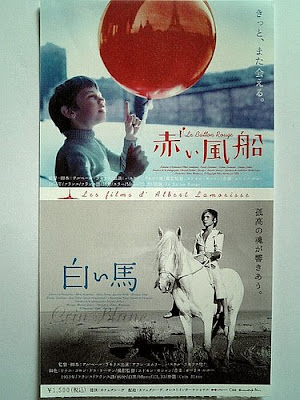
To celebrate finally getting a television (even if the arial is not co-operating), a small package from dear old Amazon turned up this morning with Albert Lamorisse's The Red Balloon and White Mane. Though I had bought it for the more well known The Red Balloon, I actually loved the story of the wild horses and little fisher-boy set in Camargue, France. 


In both, Lamorisse captures two young innocents seeking escape from a world of corruption and brutality via their chosen mediums - a beautiful independent horse and a magical red balloon. Both keep the boys company in their harsh settings, each ending in mysterious manners that allow the two to return to the supposedly more fair and understanding worlds of their companions - one swims out to sea and to "a wonderful place where men and horses are friends, always", and the other is transported high high up above Paris by a whole cohort of multi-coloured balloons. Lamorisse was formerly a documentary-maker which is evident in his style, and this ability to portray with 'realism' is in harmony with the fairy tale nature of the stories.


Alain Emery, who plays the young boy Falco, had to learn how to ride and for most of the film he seems to be galloping bareback! For the scene in which he is dragged by White Mane through marshes and onto the beach, Lamorisse himself did the stunt double.


White Mane 1952

The Red Balloon 1956

Truly recommend both films - very inspiring and beautiful. Visually, White Mane is stunning as the arid, bright seaside marshes are brought to life in black & white, while The Red Balloon is a colour-saturated feast for the eyes.

Wednesday, 11 February 2009

Fairytale Otherworlds

This is some of the incredibly atmospheric work of the Spanish photographer Eugenio Recuenco. I can't help but appreciate his use of light and dark, and all of his images have an alluring quality that seem to pull you head first into their worlds. He has had a lot of success particularly in fashion already, and he is very good at keeping his online portfolio updated, so it's definitely worth a look every now and then...

That's me in Lapland after I leave Uni. Just me, the sleigh, and a bunch of nice reindeer hides thank you very much.

Surely faeries exist...

Scrap that last post, THIS is my new bed of choice.

Whot? Everyone needs the odd husky in Lapland. 

Special Corner

Just a little mood board if you will - or simply lovely rejects I accumulated from the last post that were misfits for the theme. So here they are in their own special little corner, for special things. Aw. Special.

The kitten child. 

I actually happen to own this (deeply smug voice). Well, ish. I picked up a 60s copy last saturday at Portobello Market; got a good deal as the equally tasteful Elizabeth got one portraying a succulent red rose for her mother dearest. Now where to put it...

Bell jars and gilt frames, 'nuff said.

Tuesday, 10 February 2009

Sleeping Beauties


I've decided that my little guest bedroom is crying out for some attention. It has finally been graced with a fully-functioning-if-squashed-in mattress sleigh bed and i've gotten some hotch potch floors sanded in there, all of which is highlighting the horrendous 'tarrow root' shade of the walls as unforgivable. So, where to start? Right here of course! Ha!


I love this disheveled little Indian-inspired day bed. Especially the photograph positioned on top of the wall hanging - another nifty way of making a cosy nook.


This bedspread is by Emery & Cie, and they currently have some spellbinding wallpapers and textiles. I don't know if i'll be able to exercise my resisting powers...

This is a little grander, and a lot French-er. Lord only knows i'd do it if i was blessed with parquet flooring, but i'm not, so perhaps i'll stick to the rank of my room and go for muslin rather than full-on glorious silk satin. 

Sighhh... bed genius. What child/adolescent/adult would NOT absolutely LEAP into that warm haven? My only concern is I might have to sleep diagonally, but worth it for the carved panelling and curved ceiling...

A bedroom from the fabulous Mildred's Lane. 

 A more laid back and shabby french take on the above - love the fabric type.

This gypsy-like glory reminds me of something I would have created if I'd been allowed to run riot in the house, picking out choice fabrics from the cupboard and only the best chairs from the kitchen! 


According to the National Sleep Research Project, the pre-electric eras got an average of 10 hours of good sleep a night, with adaptation to the seasons - much like our fellow cousins the chimpanzee. It's now considered good going to get 8 hours. As for those between 18 -25, we're far more affected by sleep deprivation, and the internet is considered one of the worst influences... gosh, it's getting late... off to Bedfordshire... Zzzzzzz zzz zzzzzz...